
What Is a Flame Guard and Why Your Gas Pizza Oven Needs One?
Share
What Is a Flame Guard and Why Your Gas Pizza Oven Needs One
If you've ever pulled a pizza out of your Gozney with one side charred black and the other barely cooked, you already know the problem a flame guard solves.
You're standing there with a perfectly good dough, premium toppings, and fresh mozzarella—and your oven turns it into a unilateral disaster. The side facing the burner looks like a hockey puck. The other side looks like it came out of a toaster oven.
This isn't a skill issue. It's a physics issue. And the solution is simpler than you think.
The Problem: Home Pizza Ovens Are Too Small
Let's talk about scale.
In a commercial wood-fired pizzeria, the pizza cooks 6+ feet away from the flame source. The heat radiates evenly across the dome, cooking the entire pizza uniformly. The baker isn't frantically spinning because they don't have to—the physics do the work.
In a home Gozney oven, your pizza sits inches from a 50,000+ BTU gas burner.
That's like trying to tan evenly while sitting on top of a bonfire.
When you place a pizza in your home oven, the side facing the burner gets blasted. The flame-side crust chars in seconds. Meanwhile, the back of the pizza is still raw. You spin it frantically. You spin it again. Stress levels rising. And somehow, it still comes out uneven.
You tell yourself you need more practice. You watch YouTube videos about turning technique. You adjust your launch speed. You're doing everything right—the problem isn't you.
The problem is thermodynamic. Direct radiant heat from a close flame source creates a steep temperature gradient across your pizza stone. The side closest to the burner experiences extreme heat. The far side experiences moderate heat. To cook evenly, you'd need to spin constantly or have a flame source that's farther away and larger.
You can't move your burner. But you can redirect the flame.
How a Flame Guard Solves It
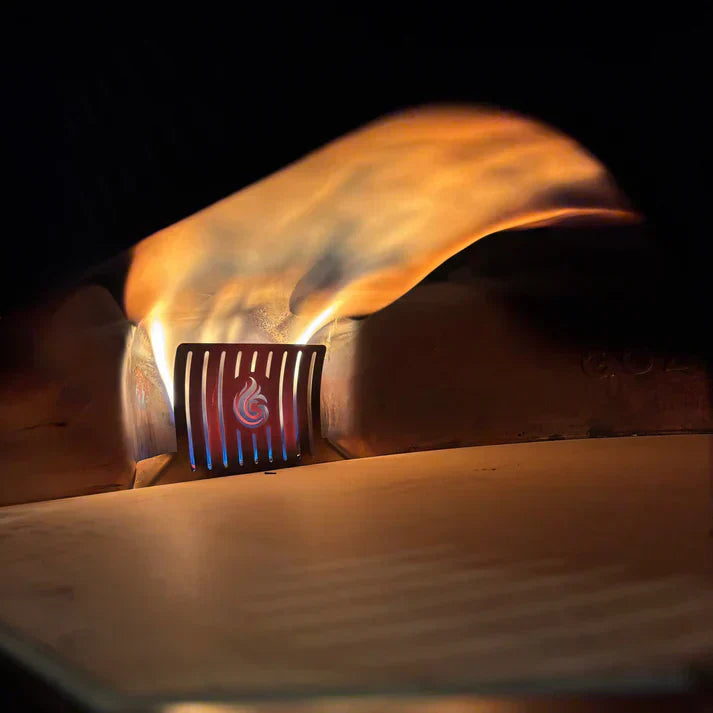
A flame guard—also called a flame shield, flame deflector, or pizza oven heat shield—is a stainless steel barrier placed between your gas burner and your pizza.
It's elegantly simple. Instead of the flame shooting directly at your dough, it hits the shield. The shield absorbs the direct heat and radiates it more evenly across the oven chamber. The result is a softer, more distributed heat environment.
But here's the clever part: different designs let different amounts of flame through.
By controlling how much flame is redirected versus how much reaches the pizza directly, you control your cooking style. Want maximum flame and speed? Use a shield with minimal deflection. Want gentle, even cooking? Use one with maximum deflection.
The benefits are immediate:
- More time before burning: The pizza isn't getting hammered by direct flame, so you have more window to cook.
- More even browning: Heat distributes more uniformly. That means golden crust all around, not charred spots and raw spots.
- More consistent results: Once you dial in your flame guard, you know what to expect. Less guesswork.
- WAY more relaxed cooking: You're not spinning every 20 seconds. You can actually enjoy the process.
The Three Types of Flame Guards (Explained)
Flame guards aren't one-size-fits-all. Different designs serve different cooking styles. Here's how to think about them:
Napoli: Minimal Deflection, Maximum Flame
The Napoli guard lets the most flame through. The shield sits at a shallow angle, letting you access direct, intense heat.
Best for: 90-second Neapolitan-style bakes. Leopard-spotted crust lovers. You want that leopard-like pattern with dark speckles and charred spots.
Why: Neapolitan pizzas are cooked fast and hot. The minimal deflection gives you the intensity you need without the off-center burning.
NY: Moderate Deflection
The NY guard provides a middle ground. It deflects some flame but lets a good amount reach your pizza.
Best for: 3–5 minute NY-style bakes. You want even browning and a crispy base without leoparding.
Why: New York pizzas are cooked longer and cooler than Neapolitan. More even heat and less direct flame intensity creates the perfect golden crust.
PAN: Maximum Deflection
The PAN guard deflects the most flame, creating the gentlest cooking environment.
Best for: Detroit-style pizzas, pan pizzas, bread baking, roasting vegetables. Basically anything that isn't Neapolitan and benefits from gentle, indirect heat.
Why: Detroit-style pies cook for 8–10 minutes. Maximum deflection prevents the bottom from burning before the top finishes. Plus, that same gentle heat is perfect for bread or roasting.
Think of it like an oven's heat setting: Napoli is broil, NY is high, PAN is standard.
"But Do I Really Need One?"
Let's address the skeptics.
Some people argue you can manage without a flame guard. Spin faster. Manage your flame better. Position your pizza more carefully. That's all true—technically, you can cook without one.
But it's like driving without power steering. You can do it, but why would you?
A flame guard isn't a crutch for bad technique. It's a tool that lets good technique become excellent technique. It removes a physics constraint and lets you focus on the things that actually matter: dough fermentation, temperature, hydration, shaping, and timing.
Here's what real customers are saying:
"Before I would have to keep turning the pizza quickly... Definitely will say this product works as described."
"Prevents my pizza from burning!!!"
"Good design and works. Less burning and crispier crust overall."
"I loved it so much I bought 2 of each styles."
That last one says it all.
What to Look for in a Flame Guard
Not all flame guards are created equal. When choosing one, pay attention to four things:
Material: 304 Stainless Steel
You need food-grade stainless steel that won't corrode or degrade at high temperatures. 304 stainless steel is the standard. It's durable, corrosion-resistant, and safe for cooking surfaces.
Cheaper alternatives (aluminum, painted steel, low-grade stainless) will rust, corrode, or flake over time. You'll be replacing them every season.
Fit: OEM-Spec Precision
A flame guard needs to fit your specific oven perfectly. Wobbly shields create gaps. Gaps let flame escape unpredictably, defeating the purpose.
OEM-spec means the shield is precision-engineered for your exact oven model—whether it's a Gozney Arc, Arc XL, Dome, or Roccbox. Drop it in. No modifications. No wobbling.
Design: Precision-Cut, Not Generic
A one-size-fits-all piece of metal won't perform like a precision-engineered shield. The angle, thickness, and shape all matter. They determine how the flame is deflected and how heat is redistributed.
Real flame guards are designed by engineers who've tested them in actual ovens.
Brand: Firecraft Engineering
Firecraft products are precision-engineered specifically for Gozney models. They're designed, tested, and manufactured with the same level of care as the ovens themselves. When you buy a Firecraft gozney flame guard, you're buying something engineered to work flawlessly with your specific oven.
Compatibility: Which Oven Do You Have?
Firecraft flame shields fit these models with zero modifications needed—just drop in and cook:
- Gozney Arc
- Arc XL
- Gozney Dome
- Gozney Dome Gen 2
- Gozney Dome XL Gen 2
- Gozney Roccbox
Check your oven's model on the back or bottom. Then grab the matching flame guard. No guesswork. No installation videos. Just perfect fit.
Pro Tip: Pair Your Flame Guard with a Baffle Door
While you're optimizing your oven, consider pairing your pizza oven flame shield with a baffle door. Together, they give you complete heat control—the shield manages direct flame intensity, and the baffle door manages overall oven temperature.
It's the one-two punch for consistent, repeatable results.
The Bottom Line
A flame guard solves a real problem: the physics of cooking pizza in a small, intensely hot space. It's not magic. It's engineering. And it works.
If you're tired of uneven pizzas. If you're spinning frantically. If half your pie is charred and half is raw—a flame guard is the upgrade you've been waiting for.
Choose the style that matches your cooking ambition (Napoli for speed, NY for balance, PAN for versatility), verify it fits your oven, and get cooking. The next pizza you make will be noticeably better.
Because the problem was never you. It was your heat distribution. And now it's fixed.
Ready to Upgrade?
Explore our full collection of flame shields and heat guards. Whether you're into Neapolitan, NY style, or Detroit style pizzas, we have the right guard for your oven and cooking style.
And if you're not sure which one, we're here to help. Firecraft is the official Firecraft partner in Canada—we know Gozney ovens inside and out.


